


Everything you need to know about Gdańks before your trip; from currency to language, local festivals, time zones & safety of the water. Plus great ideas about what to see, do and eat while there!


In it's 1st written mention, c.997, it's rendered Gyddanyzc then later Kdanzk & Gdanzc in the 12c. In the 13c it became Gdańsk (as it is always called in Polish documents) but Danceke, Danzc, Danczk, Danczik and eventually Danczig also emerged in the 13c - 15c, and it is still called Danzig in German.
† Currently known as the Motława


@ a glance essentials:

Language:
Polish
_
Many Locals can speak English
Polish Zloty


Water safety
Generally Safe to Drink, taste varies by region.
Currency:
PLN
Local Transport
Walkable with Bus, Tram, Metro, Ferry, SKM & Trains sufficient for the city.

.

Amber capital of the Baltic🔍, (with amber just washing up on beaches) Gdańsk is Poland's principal seaport and one of it's oldest cities🔍. Peopled since the Neolithic era ~5000BC, it's been more formally settled since at least the early Iron Age by the Pomeranian culture who built fortified structures and show indications of seas🔍 trade along the coast.
The Slavic🔍 Polans began settling the lowlands in the 6 & 7c AD and the current city was founded ~980 when the Polish Duke who 1st unified Poland established a stronghold at the port.
a bit of background...
CHECK OUT THE:
......................WWII started in Gdańks, with the first shots of the war fired there @ the Nazi's 卐 invasion of Poland† and the Solidarity Movement, that eventually triggered the fall of the entire Soviet ☭ Communist system, also first gained traction in the shipyards of the city.
† The Polish held off the Nazis for more than a week
FUN FACT:
It's location along on the amber trade routes attracted German tradesman. And in 1308, when under siege by Brandenburgs (of the Holy Roman Empire) they turned to these Germans for assistance. The Teutonic Knights happily ousted the Brandenburgs, but then took the city for themselves, (slaughtering most of the locals) and incorporated it into their monastic state🔍.
A series of Polish–Teutonic Wars, resulted in the Teutonic Order maintaining control of Gdańsk (or Danzig as they called it) but officially under the overlordship of the Polish King.† It was thus primarily populated by Germans by the mid 14c. joining the Hanseatic (trade) League ~1361.
Teutonic Order was unpopular however and in 1454 the city appealed to King to be re-integrated into the Polish Kingdom🔍 leading to the 13 year war. The city then remained part of Poland through the union with Lithuania and, initially, even after the 18c dissolution of the Polish-Lithuanian Commonwealth🔍, but at the second partitioning, like the rest of the region, Gdańsk too was absorbed by Kingdom of Prussia in 1793.
During the Napoleonic Wars the city briefly became the Free City of Danzig, as client state of the French Empire🔍 for about a decade until it was re-captured by Prussian-Russian forces in 1814, and restored to Prussia when France was defeated.
At the unification of Germany in 1871 Danzig officially became part of the German Empire until their defeat in WWI when it again became the Free City of Danzig from 1920 to 1939, under League of Nations oversight. In WWII it was occupied by the Nazi's and then captured the Soviets and finally returned to Poland, (which was under Soviet control at the time.)
† Though control bounced back and forth through multiple conflicts a few times over the next two hundred years, and the city was part of the foundation of the Prussian Confederation, that opposed the Teutonic Order.
Danziger Goldwasser† ("golden water" / Goldschlager) - famous local vodka herbal liqueur, w/ gold flakes
Pierogi - half-moon dumplings filled w/ potatoes, pork, cheese or fruit ∞ Kopytka - mashed potato dumplings
Kielbasas (sausages) like thin dry Kabanosy & white Biała ∞ Śledzie po Kaszubsku†† - pickled herring
Zapiekanka - roasted topped baguette, street food called the Polish Pizza 🍕 ∞ Żurek -sour rye soup
Bigos (Hunter’s Stew)- ried meat, mushrooms & sauerkraut stew ∞ Kotlet Schabowy - breaded pork cutlet
Pączki - round, deep-fried doughnuts ∞ Hamantaschen - traditional Jewish, triangular pastry
Szarlotka - cinnamon pastry ∞ Sernik - traditional curd cheesecake w/ dried fruits & chocolate coating
Kostka Kokosowa - small cubed sponge cake dipped in chocolate sprinkled w/ coconut
Sękacz - tree cake [a thick batter repeatedly poured over a rotating horizontal spit creating the shape of a tree]
a softer, more delicate version than it's German/ Belerussian cousins
Seinų, aka Miód z Sejneńszczyny - honey from a polyfloral nectar in a specific Polish/ Lithuanian District
➿➰➿
† Dating to the 16c, once considered a luxury medicinal drink †† 13th century, served w/ sour cream, onions, apples & egg

Must Try Local Cuisine:
SEE
DO TRY
&
VISIT
What to Where to Why . . .
Highlights:

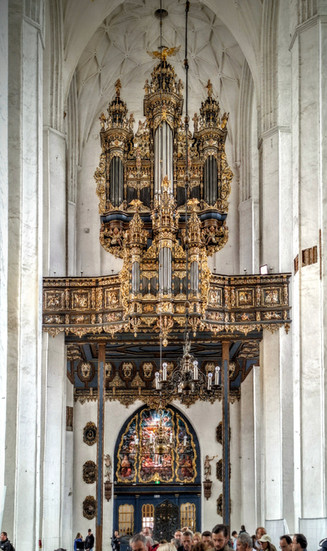
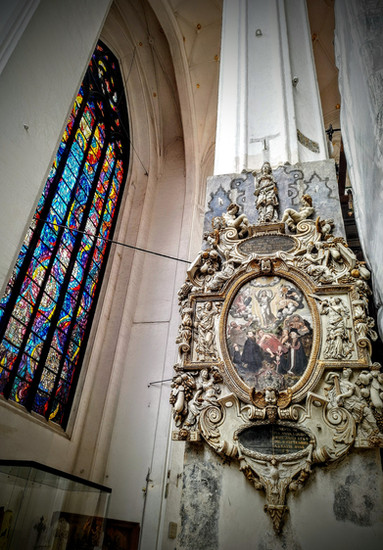
📍 Medieval St. Bridget's Church 📸 - with one of the world's largest amber altarpieces 📸 &
skull filled catacomb 📸
📍 Tower Clock Museum 📸 (part of Museum of Science) - in St. Catherine's Church 📸,
oldest church🔍 in Gdańsk & home to the world's first pulsar clock 📸
📍 Basilica of the Assumption of the Blessed Virgin Mary 📸 (St Mary's Cathedral) - 14c Gothic,
largest brick church in Europe, with 15c Astronomic Clock 📸, 45ft tall, possibly world's
tallest wooden clock. [There's also the world’s 2nd largest brick church St. Nicholas' &
Archcathedral Basilica of the Holy Trinity, known for its baroque organ concerts]
📍 Główne Miasto (Main Town) - with Neptune’s Fountain, Fahrenheit Monument 📸,
(antique thermometer honoring the creator of the 1st universal temperature scale), plus...
📍 Town Hall Museum & Clock Tower 📸 all in the 13c Long Market / Długi Targ 📸 (a market street in place of
the usual market square,) lined with pastel facades & historic buildings like...
📍 Uphagen House - a reconstructed 18c merchant house now a branch of the historical museum & one of only a few
18c merchant town houses in Europe open to visitors and...
📍 Dwór Artusa (Artus Court) - restored Hanseatic merchant court/ palace dedicated to legendary King Arthur with
bizarre Renaissance art. Today, it houses a city museum & hosts cultural events.
† Completed 1502, one of the largest in the world, holding up to 25,000 people, The clock tracks the moon, sun, zodiac, & a calendar of the saints.; plus has a rotating
parade of apostles, death, & the 3 kings that appear daily at noon.
Surprises:
📍 "Beer 🔔 Bell" in the Golden Gate - once used to announce the opening of pubs, one of the few "Beer Bells" still in
existence. (Historic High Gate & Green Gate on the Royal Route, are also worth a visit)
📍 Lunar Rover 📸 - Hidden, carved into a (renovated) bas-relief on Mariacka Street (obblestone street of beautiful
architecture known for jewelry boutiques, amber shops & cozy cafes.)
📍 Old Prussian Hags 📸 - rare stone sculptures, some of the few remaining physical artifacts of Old Prussian culture.
📍 U-Boat Locks Ropes Course | Leśniewo - originally built for German U-boats in never-completed Masurian Canal
📍 Cemetery of Lost Cemeteries🔍 - memorial to the dead of Gdansk, whose resting places were destroyed in WWII
📍 Museum of Witchcraft - history and folklore+ superstitions surrounding witches











Most Known For:


♦️ Ruins @ Westerplatte - the site where WWII began, with memorials, and a peaceful
walking area plus an extraordinary Museum of the Second World War
🔸 The Motława River Promenade with famous Stary Żuraw, Medieval Port Crane (used
for loading/ unloading cargo-ships), Straganiarska (Market Stall) Gate, 14c Teutonic
Swan Tower & vintage Carousel 🎠 @ the Fish Market, Royal Granary, and shipyards;
birth place of the Solidarity Movement that helped bring down Soviet communism
in Central Europe.(a story explored in the European Solidarity Centre)
♦️ Amber seen in nearly every market stall, shop & @ the Amber Museum, covering the
history of the amber trade + examples of Baltic amber
🔸 Lew Hewelion - bronze lion 🦁 mascot sculptures scattered all across the city 📸
♦️ Wisłoujście Fortress - 700-year-old unique circular defense structure
🔸 Hala Targowa (Market Hall) - historic market plus 12c archaeological remains inside the hall
♦️ The Great Mill - historic water mill dating back to the 14c that now houses an art gallery
🔸 Old Railway Station - still in use, you can even ride on the Historic Narrow-Gauge Railway (summer only)
📽️ NOTABLE FILMS SHOT IN GDAŃSK:
⭐ The Tin Drum† | 1979 ⭐ Zero Dark Thirty | 2012
(Die Blechtrommel) (CIA black site = Gdańsk-Wrzeszcz air base.)
🎮 The Witcher 3: Wild Hunt (video game) | 2015
Gdańsk Crane, on the waterfront, inspired the city of Novigrad's port
† Oscar winner for Best Foreign Language Film
🍿
..................... It's said the people of Gdańsk were once so rich they threw so many gold coins in the Neptune Fountain for luck, that Neptune became angry at the clutter, broke the coins & turned the fountain water to vodka thus inventing Gdańsk's famous liquor 🍸 Goldwasser.


🌀 St. Dominic’s Fair (Jarmark św. Dominika) (July - Aug) Traditional fair/ Street festival, one of Europe’s oldest
(since 1260). Hundreds of stalls selling amber, crafts, food, music, performances & fireworks. + various Amber
Marathon & Amber Expo events
🌀 Baltic Sail, Maritime Festival (Summer)- celebrating seafaring heritage; ship parades, sea battles, concerts, e.g.
🌀 International Organ Festivals (July-Aug) - including free & inexpensive musical performances
🌀 Mozartiana (Aug) Open-air classical music concerts in Oliwa Park plus various "Crane Concerts.” set against the
backdrop of the famous medieval crane
🌀 Krampus/ Perchten (Dec) - where the ominous half-goat, half-demon, Krampus (a creepy companion of Santa
Claus) roams the streets to punish misbehaving folk, while well-behaved receive treats from Santa.
(It is customary to offer the Krampus a schnapps to get on his good side)
🌀 Midsummer Night (Wianki = wreaths or Kupalnocka / Noc Kupały) - celebrations on the Motława River, in
addition to bonfires, young women make wreaths from wildflowers, herbs & ribbons, place a lit candle in the
middle and float them on the rivers it floats far and stays lit means good luck; a marriage, or a bright future, if
it sinks it's a bad omen.
Close Enough to Visit:
🪧 Sopot's Beach & longest Wooden Pier in Europe (500+ meters long), plus Gdynia (the other two parts, of the Coastal
Tricities) - with haunted, deserted Hotel Zdrowie & Torpedownia; abandoned WWII torpedo launch station
🪧 Toruń - with Nicolaus Copernicus House & Museum + Gingerbread Museum, once a giant gingerbread factory, that
now hosts exhibits & workshops
🪧 Moving Sand Dunes of Słowiński National Park - the massive dunes swallowed an entire village
🪧 Stutthof Concentration Camp & Memorial site
🪧 The Stone Circles @ Odry - Iron Age megaliths deep in the forest
🪧 Bydgoszcz - with The Exploseum, abandoned Nazi explosives plant founded by the inventor of dynamite, now an
underground museum + the Museum of Soap & History of Dirt + the stunning Fara Church with secret Polish Eagle
that survived occupation during WWII, hidden in plain sight
🪧 Malbork Castle - 13c Gothic brick, world's largest by surface area OR Łapalice Castle - 20c, abandoned incomplete
🪧 Stary Browar Kościerzyna - historic Brewery & Hotel with "Beer Spa" (hop bath) & nearby
Upside-Down House | Szymbark, - meant to be a symbol of communism's topsy-turvy effect
🪧 Carthusian Church Monastery | Kartuzy - a coffin-shaped church was once home to monks who slept in coffins.
Site Key:

Five Star Recommend
Make the Time!

Worth the Effort/ $


Going to visit
Make a DONATION of $5 or more and receive a FREE Thank You Gift of a FULL CITY TRAVEL GUIDE with even more favorites and the address/ contacts for all recommendations. Just include your EMAIL ADDRESS in the transaction description of your donation along with the word
GDAŃKS
GDAŃKS

UNMOORED DETAILS DESTINATIONS PLAN YOUR TRIP ON A BUDGET TRAVEL BLOG
YOUR HOST- JULIA EUROPE PLANNING, PACKING & PASSPORTS HISTORY & CULTURE
SPECIAL THANKS AFRICA & MID EAST BOOK TRANSPORTATION MYTHS, LORE & LEGENDS
PRIVACY & TERMS OF USE ASIA & OCEANIA SLEEPING ARRANGEMENTS FRIENDS & ADVENTURES
CONTACT THE AMERICAS TRAVEL INSURANCE LOCAL FESTIVALS


Notices: Unmoored is not a licensed travel agency. The Site's intended to educate, inform & entertain and is not to be used as a source of official travel itinerary planning, or legal advice. It is merely the experiences and reflections of fellow traveler. - The site may contain affiliated links, (there is never any extra cost to you for using these links) but Unmoored only includes affiliated links for products/ companies that we would willing endorse on the site even without the affiliation.