

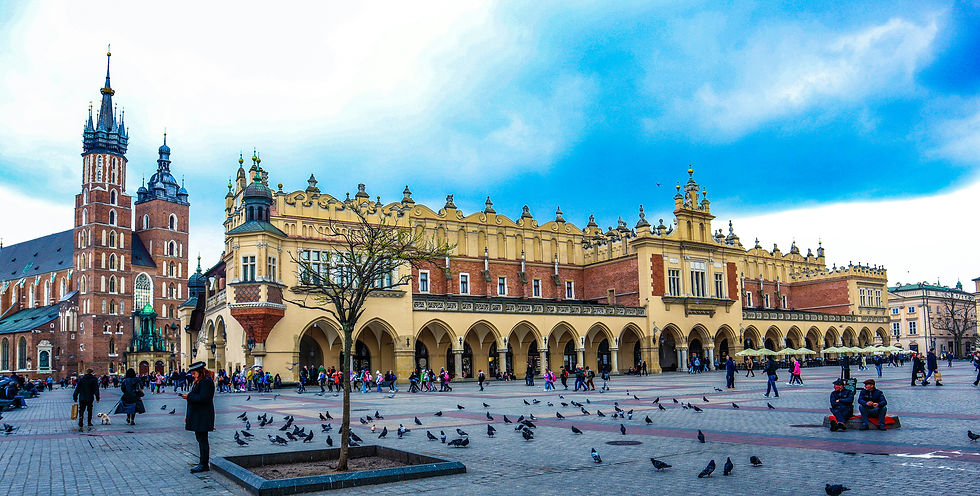
Everything you need to know about Kraków before your trip, from currency to language, local festivals, time zones & safety of the water. Plus great ideas about what to see, do and eat while there!


Ruler of the Wiślanie/ Vistulans, a Slavic Lechitian tribe,† he is said to have built the city above a cave occupied by a dragon, Smok Wawelski, (i.e. the Wawel Dragon.) which he slew.
Krakus/ Krak may be related to pre-Slavic krakula = judge's staff/ scepter, evoking authority, kruk = crow / raven evoking intelligence or even dąb = oak tree, a sacred tree in Slavic paganism associated with strength, genealogy, & authority.
† Though this is disputed; the 1st recorded Prince Krakus (Grakch) was in 1190, but the town had already existed ~400 years. Alternatively the city's name could be derived directly from kruk = crow / raven with the legendery fouding figure attached later.


@ a glance essentials:

Language:
Polish
_
Polish Zloty


Water safety
Generally Safe to Drink, taste varies by region.
Many Locals can speak English
Currency:
PLN
Local Transport
Bus, Tram & Trains mostly sufficient


The 2nd largest Polish city🔍, (and most visited) Kraków tracies back to the West Slavic🔍 Wiślanie (or Vistulan) tribe that settled in the area by the 7c AD, establishing a fortified city in the 8c, but humans had been living continuously in/ on the Wawel Hill region of Kraków since the Neolithic period,
Before being incorporated into the 1st unified Polish state🔍 ~990 AD the city was a significant commercial hub under Moravian control, then captured by the Bohemians🔍. But after unification it soon became the de facto capital of the new Kingdom🔍 in 1038, when the king moved his royal court there.
a bit of background...
CHECK OUT THE:
MY FAVORITE SPOTS TO...
................ Commemorating a trumpeter 🎺 who warned the city of a Mongol invasion in 1240, a traditional five-note Polish tune is played every hour on the hour for centuries from St. Mary's Basilica🔍. (Only 5 🎶, because the trumpeter was killed, and his original tune stopped short)
The tune is so famous the noon playing is broadcast globally on via radio for Poles around the world.
FUN FACT:
It was largely burned in 13c Mongol invasions and had to be rebuilt. In 1596 the royal court was moved away from Kraków to Warsaw, more centrally located capital within the new, expanded, Polish-Lithuanian Commonwealth, diminishing Kraków's prominence (though the city is still used as Polands coronation site)
At the 1st Partition of Poland in 1772, when the Commonwealth🔍 dissolved, Kraków came under the control of the Habsburgs in the Austrian Empire. It was the epicenter of the 1794 failed uprising against Russian & Prussian forces, (where scythe-wielding peasants famously routed a larger Russian contingent, just outside the city.)
The city briefly joined the Duchy of Warsaw in 1809, (then a client state of Napoleonic France) until it was declared the Free City of Kraków (an independent republic🔍) in 1815 (when Napoleon was defeated in the 100 day war.)
In the 19c it was a refuge for Polish patriots fleeing repression, until insurgents seized parts the city in 1846, which triggered the Austrians to mobilize against the rebels and annex the city, re-absorbing it into the empire🔍, as the capitol of the simultaneously formed Grand Duchy of Kraków.
During WWI Kraków functioned as a fortress city for (now) Austria-Hungary, repelling the Russian advances. After the war, with the seperation of Austria & Hungary, the city was finally reunited with the rest of Poland..
Must Try Local Cuisine:
Obwarzanek Krakowski (Kraków’s iconic blue-cart street snack)† - braided ring-shaped boiled bread (precursor & similar to bagels or pretzels) topped w/ poppy seeds, sesame, salt e.g.
Pierogi - half-moon shaped dumplings ∞ Kielbasas (sausages) like Krakowska, a dry, seasoned cold-cut
Zapiekanka - roasted topped baguette, street food called the Polish Pizza 🍕 ∞ Żurek -sour rye soup
Kopytka - mashed potato dumplings ∞ Maczanka Krakowska - sliced pork sandwich in a thick gravy
Oscypek -Smoked sheep’s milk cheese from the nearby Tatra Mountains, often grilled & served w/ cranberry jam
Placek - grated & fried potatoes cakes coated w/ sour cream or sugar & Placek po Zbojnicku w/ meat, sauce
Kremówka Papieska (Papal Cream Cake††) - puff pastry filled w/ custard ∞ Pączki - round, fried doughnuts
Szarlotka - cinnamon pastry ∞ Seinų, aka Miód z Sejneńszczyny - honey from a specific Polish/ Lithuanian District
Sękacz - tree cake [a thick batter repeatedly poured over a rotating horizontal spit creating the shape of a tree] a softer, more delicate version than it's German/ Belerussian cousins
Kostka Kokosowa - cubed cake dipped in chocolate & coconut ∞ Hamantaschen - traditional Jewish,▽ pastry
➿➰➿
† Invented by Krakow Jews, it has protected status, requiring certification, considered a symbol of the city †† Associated w/ Kraków because it was a favorite of Pope John Paul II, from Krakow

SEE
DO TRY
&
VISIT
What to Where to Why . . .
Surprising Finds:


📍 Wieliczka Salt 🧂 Mine - cavernous chambers, statues, chapels, chandeliers & cathedrals carved out of salt, @
depths of 300+ meters, (continuously mined since 13c & one of Krakow’s main industries. In use until 2007)
OR
📍 Bochnia Salt 🧂 Mine - less deep, but the oldest salt mine in Poland (c1248) now used as a health sanatorium in
its own unique micro climate, (thought to help with respiratory diseases) in a 150m chamber with 140 bunk beds,
with a chapel🔍 carved of the salt, a gymnasium, and a spa.
📍 Nowa Huta - one of only two fully-planned Socialist Realist cities ever built† meant to be a “utopian” city
established after WWII, filled with communist-era apartment blocks & Nuclear Bunkers under the city & the...
📍 Kraków-Płaszów Train 🚂 Graveyard - cemetery of rusting Soviet-era steam train, overrun with vegetation
in a forgotten railyard c1908 (Including relics like TY 51, the heaviest Polish steam locomotive from the 50s)
† The other being Magnitogorsk, Russia
My Favorite Spots . . .

📍 Royal Road (or Royal Route) the route Polish kings took for coronations, parades, etc to Wawel Castle, starting from
St. Florian’s Gate, Gothic tower; the only surviving medieval gate (~1300) in:
📍 Old Town, which includes Gothic, Renaissance, & Baroque buildings, plus the Main Market Square, largest
medieval town square in Europe with restored 14c Town Hall Tower Museum (Wieża Ratuszowa) and the famous...
📍 Renaissance Cloth Hall† now housing stalls of traditional Polish crafts, the Sukiennice Museum, of 19c Polish art and
examples of Torch Sockets used put out torches before one entering a building lining the main gate entrance) plus
Rynek Underground Museum, (centuries-old aqueducts, well-preserved medieval streets & a settlement destroyed
by Tatars in 1241, plus an 11c cemetery🔍)
📍 District of Kazimierz / Jewish Quarter .- former Jewish ghetto dating to the 14c, now a vibrant
artist & student neighborhood, known for vodka bars, flea markets like Plac Nowy, the Galicia
Jewish Museum, Jewish cemetery and the oldest synagogue in Poland, appropriately known
as the Old Synagogue
†† The knife is connected the legend of Fratricide/ Suicide of St. Mary's towers across the square (See Below.) Alternatively the
knife is said to have been a deterrent against thieves in the Middle Ages when, theft was punished by losing an ear or an
arm e.g.. (Ironically, the knife is a replica as the original was stolen during WWII)
... to Wander & Explore:
... to Visit:

A Plethera of Beautiful Churches🔍 including:
📍 Wawel Cathedral 📸 - with Bones of "Dragon" 🐉 Smok Wawelski,† crypt & Sigismund Tower Royal 🔔 Bell cast
in 1520, tolled on days of great royal or national importance, so massive at 13 tons it takes 12 bell ringers
to toll! Local legends claim touching it when no one is looking will bring love to the lonely 📸
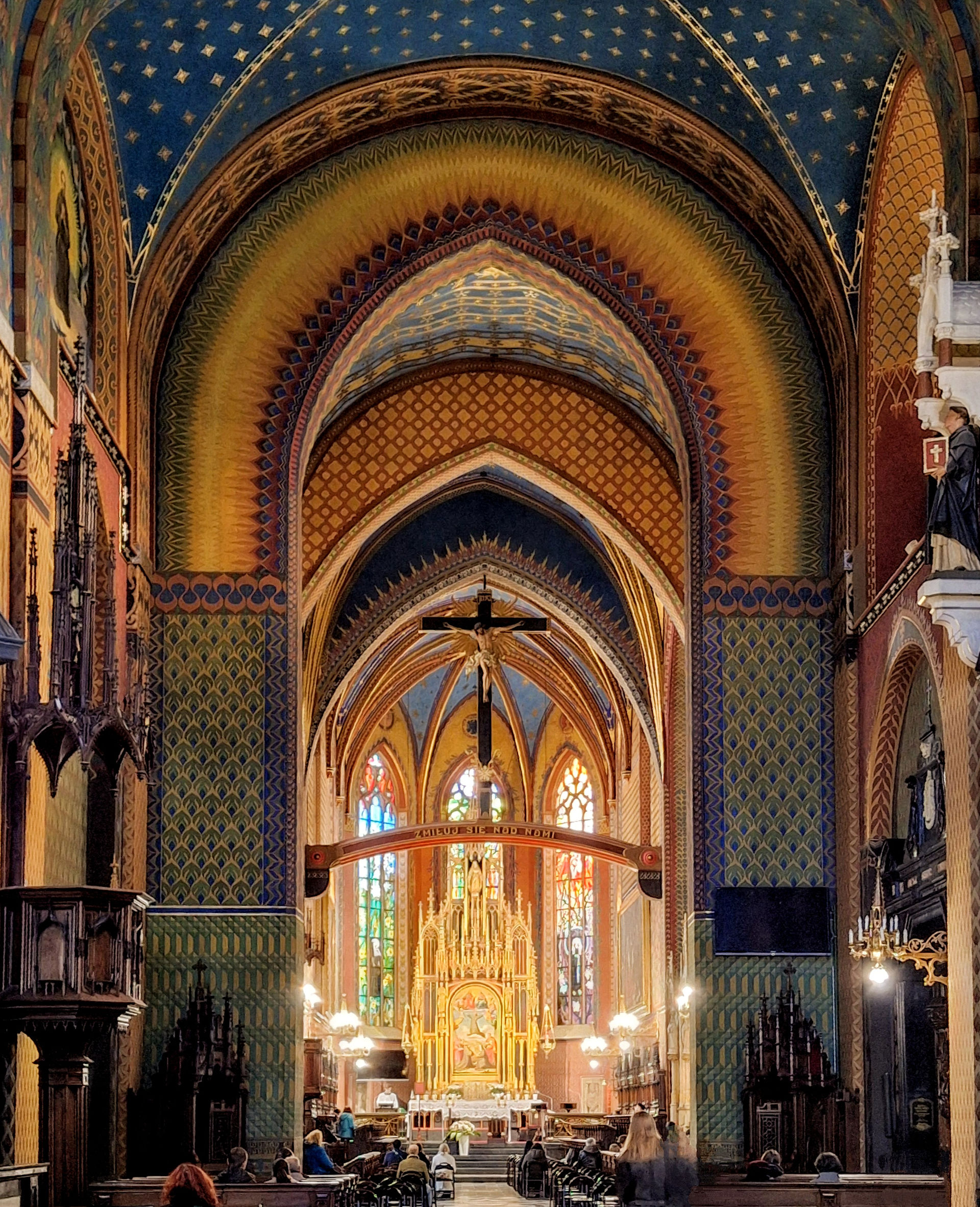
📍 St Francis of Assisi Basilica (& Friary of the Conventual Friars Minor) - 13c Gothic renowned for its stained glass,
frescoes, in bright psychedelic color, residence of Pope John Paul II 📸
📍 St. Andrew's Church 📸 & Tiny Church of St. Wojciech 📸 - both 11c stone Romanesque with baroque bits
📍 Kalwaria Zebrzydowska - 17c monastery in the Mannerist (Late Renaissance) style, Surrounded by 3 miles of
pilgrimage routes and 42 chapels & churches. Tours are 🆓 (but must be booked in advance)
📍 St. Mary's Basilica (Mariacki church) 📸 - 13c Gothic; asymmetrical towers†† & a trumpeter 🎺 playing hourly
(see fun fact above.) One of the most elaborate cathedral interiors in Europe; painted, carved, frescoed & tiled,
known for it's main altar carved from wood & a triptych, the largest Gothic altarpiece in the world (40' x 34')
depicting Biblical characters / events, most prominently the Assumption of the Madonna



📍 Church of Saints Peter & Paul 📸 (1597-1619) - formerly Jesuit, largest historic church. and oldest Baroque
architecture in Kraków; decorated with stone sculptures of the twelve apostles at the gate, trompe-l'oeil
ceiling paintings & home to a large Foucault Pendulum
📍 Church of St. Casimir the Prince (aka Reformati / Observant Franciscans Church) 📸 - 17c, with stunning
vault frescoes & one of Kraków’s most unusual crypts of unique microclimate caused natural mummification
where many bodies remain remarkably well preserved, some still sitting upright without coffins.
(The crypt is normally closed to the public but opened on All Souls’ Day)
📍 Basilica of Corpus Christi 📸 - 14c Brick Gothic & lavish Baroque interior, boat-shaped pulpit and the
confessional/tomb of St. Stanisław Kazimierczyk
📍 Church of St. Anne (Kościół św. Anny) - 17c Baroque, rich stucco work and extensive frescos OR
Church of St. Barbara (Kościół św. Barbary) Gothic & Baroque
† Actually thought to be fossilized whale bones or mammoth bones.
†† The towers are said to have been built by two brothers; when the younger saw that the elder’s was going to be taller, he stabbed him to death only to later climb to the top of his now taller tower, confess & stab himself with the same knife which is now hanging in the Cloth Hall (See Above)
... to Commune w/ 🌳 Nature:

📍 Jagiellonian University’s Botanical Garden - 18c, oldest botanical garden in the country
with greenhouses, themed gardens & over 5,000 species of trees, shrubs, orchids & flowers
📍 Planty Park (The Green Ring)- once the moat encircling the medieval city walls, now a 4km
park around historic Old Town
📍 Zakrzówek Park & Lagoon - former limestone quarry turned water reservoir surrounded by
cliffs. With cliff jumping, swimming, rock climbing & hiking/biking trails
📍 Henry Jordan Park (by Błonia Commons) - Europe’s 1st public playground c.1889 with
Wojtek the Soldier Bear Statue; a memorial to beloved Syrian brown bear that served
in the Polish army during WWII, plus sports facilities & a pond with pedal boats
📍 The Polish Mounds (man-made) honoring great leaders. like Kościuszko Mound built as a corkscrew to honor
Tadeusz Kościuszko, renowned for his battles against foreign powers in Poland OR
Kopiec Wandy (Wanda Mound) an apparent calendric structure built in the Early Middle Ages that
immortalizes a legendary Polish princess, Wanda (see LORE BELOW)

... when feeling 📚 Bookish:
📍 Biblioteka Jagiellońska with arched ceiling painted like the sky. Part of the Jagiellonian University &
Collegium Maius (Latin for “Great College”) - Poland’s oldest university building, (2nd oldest in Central
Europe after Prague) and Alma Mater of Copernicus, and Pope John Paul II.
Now also a museum of historic scientific instruments e.g.
📍 Antykwariat Abecadło - 19c pharmacy, "Guardian Angel" pharmacy. converted into a bookstore shop using
antique pharmacy furniture dating to 1899; rare books, maps & prints, hosting book clubs, & cultural events
📍 Księgarnia Bonaul - charming bookstore-café, arched brick ceilings & massive chandelier made of scrolls.
📍 Massolit Books & Café - cozy, quirky shop, new + used books
📍 Księgarnia na Rynku Głównym ("Bookshop on the Market Sqr") - one of the oldest bookstores in Europe (c.1610)
in historic Kromerowska Mansion
📍 Lokator - hip independent bookstore-café with a focus on contemporary literature & art books
📍 De Revolutionibus Books & Café - science + philosophy focused bookstore/ café run by the Copernicus Centre
in a 19c mansion
📍 Specialty shops - Bonobo Bookstore & Travel Café; for travel books & Fankomiks; for comic books
... when feeling Adverturous:
📍 Living Obwarzanek 🥯 Museum (Żywe Muzeum Obwarzanka) - 'museum' of Obwarzanek; the centuries-old
ancester to both the bagel and a pretzel, born in Kraków's Jewish quarter. An interactive presentation and
demonstration were you bake your own 📸
📍 Kayaking, Paddleboards etc. on the Vistula River
📍 Dragon 🐉 Trail - statues (mostly mini) scattered throughout the city, (usually the location is connected to
a dragon legend) including the large bronze dragon gaurding the Wawel Dragon's Cave† that famously
breathes real 🔥 fire 📸 (see LORE BELOW)


📍 Pinball/ Arcade Museum (Muzeum Gier Wideo) - interactive, 80+ restored retro pinball & 35 arcade games
📍 Aquapark / Park Wodny - water park with largest pool hall in Poland, slides, climbing walls & outdoor 'beach'
📍 Rock Climbing @ Skałki Twardowskiego | Zakrzówek - outdoor climbing
📍 Energylandia | Zator - Poland’s largest amusement park with some of Europe’s tallest, fastest roller coasters
† The cave has housed a "dragon," a brothel, and a legend about how the city of Krakow got its name. (See Lore)
📍 Cheder - Jewish cultural café in a former prayer house. Israeli-style coffee & Middle Eastern snacks
📍 Singer- quirky, artsy café/ pub where the tables are old Singer sewing machines.
📍 Cytat Café - quirky, bookish coffee shop with comfy seating.
📍 Bunkier Café - modernist “bunker” with huge glass greenhouse overlooking the park
📍 Piwnica Pod Baranami - quirky atmospheric, historic cellar bar beneath Main Market Square.
📍 Eszeweria - moody, vintage feel cocktail bar with incense and a secret garden, and strong cocktails
📍 Alchemia - dark, candle-lit cellar bar with live music
📍 Mercy Brown - jazzy 1920's themed, hidden behind a cloakroom door in a historic building.
(top rated speakeasy in Kraków.)
📍 Hedwig’s - cocktail bar inside a former Baroque, Gothic chapel
📍 Sababa Kazimierz - trendy, intimate hidden speakeasy with Jewish/ Middle Eastern influences
. 📍 Mr. Black - "where history meets mystery, and every cocktail is a journey through time & space."
drawing inspiration from the Victorian Era & Tarot
... when I'm Peckish:
📍 Pod Wawelem Kompania Kuflowa - Polish cuisine
📍 Jama Michalika - c. 1895, atmospheric Art Nouveau café, restaurant & museum, a former meeting place for artists
of the Young Poland movement.
📍 Camelot Café - romantic café, antique furniture, stained glass, old photos & wooden carvings
📍 HEVRE - cofé in a former 19c synagogue with peeling frescoes & chandeliers.
📍 Wierzynek 1364 - traditional Polish/ European fine dining - one of the oldest restaurants in Europe (650+ yrs; hosting
a legendary royal feast in 1364) multiple ornate historic rooms, antique décor & tapestries
📍 Morskie OkoPlac Szczepański - Highlander (Góralskie) folk-style restaurant with traditional mountain décor, carved
wooden interiors, known for regional Polish dishes
📍 Szara Gęś (Grey Goose) - refined Polish classics with a focus on goose dishes in a historic former bookshop
📍 Pod Aniołami - traditional Polish cuisine in rustic vaulted cellar
📍 Pod Różą (Under the Rose) - upscale Polish & international cuisine in one of Kraków’s oldest (eponymous🔍) hotels.
📍 Trzy Rybki (Three Little Fish) - modern Polish fine-dining in a restored historic building (Hotel Stary)
📍 Mleczarnia - cakes, pastries, (+ cheese/sausage platters & snacks) in a bohemian vintage vibe; mismatched
furniture & walls covered in old Jewish family photos
📍 Stara Paczkarnia - fresh pączki (Polish Donuts) including traditional rose jam filling (You can often watch them made)
📍 Cukiernia Czarodziej - bakery known for kremówka (Pope John Paul II’s favorite) & other classic Polish pastries
📍 .Lody na Starowiślnej - ice cream. ranked among the best in the world (a top Polish spot on TasteAtlas)
📍 Słodki Wentzl (Sweet Vencelík) - handmade cakes & ice cream
📍 Cukiernia Cichowscy - for classic Polish cakes 📍 Ciastkarnia Vanilla - dense cheesecakes & poppy seed cakes
. 📍 Cukiernia Józef Wilk - Modern bakery known for cheesecakes (especially peach) & creative pastries
📍 Chimney Cake Bakery - fresh, handmade chimney cakes, with sweet fillings & toppings
📍 Pijalnia Czekolady E. Wedel - c.1851, chocolate house with rich hot chocolate & excellent desserts
... for something 🍨 Sweet:
Most Known For:


♦️ Wawel Royal Castle† ( & museums 📸 )- 13c, one of the best-preserved medieval castles in
Poland, with Sandomierska Tower, crown jewels & Ottoman Empire treasures all up on:
🔸 Wawel Hill with Wawel Cathedral (See VISITS ABOVE) Plus Royal Gardens & The Lost
Wawel archeological exhibition 📸 (on the remains of the Rotunda of Sts. Felix or of the
Blessed Virgin Mary from the late 10c + the Adauctus and The Church of St. Gereon.)
♦️ Oskar Schindler Factory - of Schindler's List fame, the German factory owner who
saved 1,200 Jews from the Nazi's (bankrupting himself in the process) with
MOCAK; (Museum of Contemporary Art) on a demolished section of the grounds
🔸 Auschwitz-Birkenau - former concentration camp where ~1.3 million people were sent
& 1.1 million killed. (Paid guides tours also available)
♦️ Aleja Gwiazd (Avenue of ☆ Stars) a version of Hollywood Walk of Fame, with Poles like Roman Polanski, and
foreign stars Michael Jackson, Benedict Cumberbatch, Elvis Presley. & Celine Dion (who recorded in Polish)
🔸 Polish Aviation ✈️ Museum - consistently ranked one of the best in the world. 200 + aircraft at the former
Kraków-Rakowice-Czyzyny Airport, including 22 extremely rare planes evacuated from a museum in Germany
during WWII
† A column from Wawel Castle was incorporated in Chicago’s Tribune Tower in 1925 as a tribute to the city’s huge Polish population, one of the biggest in the world outside Poland.
📽️ NOTABLE FILMS SHOT IN THE KRAKÓW:
⭐ Schindler's List | 1993 ⭐ The Grand Budapest Hotel | 2014 ⭐ The Witcher S.1 (Netflix) | 2019
⭐ Dark Crimes | 2016 ⭐ Edges of the Lord | 2001
🍿
........................ The Wawal 🐉 Dragon beneath Castle Mount terrorized King Krak's kingdom. Knights from far & wide tried slay it, lured by promises of 💰 & Krak's beautiful daughter, Princess Wanda, but none succeeded.... until a cobbler, Skuba took a lamb 🐑 , stuffed it with sulfur (or pitch) and placed it in front of the dragon's cave as an offering.† The sulfur made the dragon so desperately thirsty he flew to the Vistula River, and drank until he could hold no more & exploded from the water pressure & burning sulfur.
Today the Wawel Dragon statue breathes real fire 🔥 every few minutes outside the Dragon’s Cave (Smocza Jama.)
† Theoldest version (from the 13c) say it way Krak's 2 sons that came up with the sulfur trick, and after it succeeded the older brother murdered the younger so he wouldn't have to share the credit, and was then banished when caught, leaving Princess Wanda to rule the kingdom.

🌀 Great Dragon Parade \Wielka Parada Smoków (June)- giant dragon 🐉 puppet parade connected to the legend of
Krak & the Wawel Dragon.(see LORE ABOVE)
🌀 Lajkonik (June) - parade commemorating a legendary victory over a 13c Tatar invasion;† led by Lajkonik; a man
dressed as a Tatar (Mongol) warrior, a tall pointed hat, and long black beard, riding a wooden hobby horse
followed by a group of flisacy (traditional Vistula River raftsmen) & standard-bearer with a white eagle flag
(dates back to the 14c or earlier)
Along the route, the Lajkonik “blesses” people by tapping them on the head with his wooden mace or baton,
considered good luck for the year ahead, & collecting symbolic “tribute” (small gifts, coins, or sometimes
vodka) from shops and spectators
🌀 Jewish Culture Festival (July) - one of the world’s largest Jewish culture festivals; workshops, lectures, tours of
Kazimierz, theatre, and klezmer music
🌀 Rękawka Festival (Tues. after Easter) - traditional Slavic (pagan) rituals & battle reenactments @ Krakus Mound
🌀 Misteria Paschalia (Holy Week) - classical music festival of early sacred music (Baroque, medieval, Renaissance) in
historic venues / churches
🌀 Corpus Christi Procession (May/June) - religious procession, colorful traditional costumes (and sometimes
floral carpets in villages nearby)
🌀 International Soup Festival – with soups 🍲 from around the world
🌀 Krampus/ Perchten (end of December) - ominous half-goat, half-demon, Krampus 👹 (creepy companion of
Santa Claus) roams the streets to punish misbehaving folk, while the well-behaved receive their treats from
Santa. (It is customary to offer the Krampus a schnapps to get on his good side)
🌀 Midsummer Night (Wianki = wreaths) - celebrations on the Vistula River, in addition to bonfires young women
make wreaths from wildflowers, herbs & ribbons, place a lit candle in the middle and float them on the rivers
it floats far and stays lit means good luck; a marriage, or a bright future, if it sinks it's a bad omen.
† Tatar invaders reached the Zwierzyniec district near Kraków but were fought off by local raftsmen (or sometimes monks) who killed the Tatar leader. One of the raftsmen then dressed in the Tatar leader’s clothes and rode triumphantly into the city.
Close Enough to Visit:

🪧 Wroclaw - with vibrant architecture, the Wrocław Dwarfs 📸 & rich historical cultural landmarks like Centennial Hall
🪧 Niedzica Castle (c 1320) & Museum- overlooking Lake Czorsztyn w/ a legend linking it to lost Incan treasures.
🪧 The Painted Village of Zalipie - quaint Polish village known for elaborate floral motifs pained on nearly every
building, bench, chicken-coop and well, a tradition practiced for centuries
🪧 Old Pęksowy Brzyzek ("Pęksa's brook") Cemetery | Zakopane† - 500+ graves including celebrated Polish
war heroes & Nazi resistance fighters, authors, poets, musicians, artists, scientists, etc. all adorned with
elaborate folk art memorials carved from raw rock, metal, or tall wooden totems, sitting behind the old
wooden Church of Our Lady of Częstochowa;
🪧 St. Annaberg Thingstätte (by Silesian Insurgents Monument) - one of the largest amphitheaters in Europe & a former
Nazi German gathering place
🪧 Oak Jozef 🌳 | Wisniowa - 650-yr-old tree, featured on the 100-Zloty bill,whose hollow trunk was used as a hideout by
two Jewish brothers during WWII
🪧 Museum of Folk Architecture | Sanok -an open-air museum of 18c homes & churches transported from various
villages in Southern Poland OR
The Dental Museum & Mummy | Racibórz- biggest collection of dental equiptment in Europe.
🪧 Gliwice Radio Tower - possibly the tallest wooden structure in the world OR
Zabytkowa Dzwonnica (Cloud Demon Repelling Tower) | Gmina - a tower in a small village that uses a sacred bell to
ward off mischievous weather spirits
† Zakopane means huts or enclosures in Polish, derived from zakopać meaning to bury referring to its historical use sheltering sheep from mountain winters, with 'bury' being used in the sense of or protection (not at all connected to the cemetery)
Going to visit
Make a DONATION of $5 or more and receive a FREE Thank You Gift of a FULL CITY TRAVEL GUIDE with even more favorites and the address/ contacts for all recommendations. Just include your EMAIL ADDRESS in the transaction description of your donation along with the word
KRAKÓW
KRAKÓW
Site Key:

Five Star Recommend
Make the Time!

Worth the Effort/ $


UNMOORED DETAILS DESTINATIONS PLAN YOUR TRIP ON A BUDGET TRAVEL BLOG
YOUR HOST- JULIA EUROPE PLANNING, PACKING & PASSPORTS HISTORY & CULTURE
SPECIAL THANKS AFRICA & MID EAST BOOK TRANSPORTATION MYTHS, LORE & LEGENDS
PRIVACY & TERMS OF USE ASIA & OCEANIA SLEEPING ARRANGEMENTS FRIENDS & ADVENTURES
CONTACT THE AMERICAS TRAVEL INSURANCE LOCAL FESTIVALS


Notices: Unmoored is not a licensed travel agency. The Site's intended to educate, inform & entertain and is not to be used as a source of official travel itinerary planning, or legal advice. It is merely the experiences and reflections of fellow traveler. - The site may contain affiliated links, (there is never any extra cost to you for using these links) but Unmoored only includes affiliated links for products/ companies that we would willing endorse on the site even without the affiliation.