


To Go a'VIKING with NORSEMEN
Updated: Aug 28
The Vikings were a seafaring people now infamous for manly warriors, with long braided hair, wielding massive axes, as they raided, raped & pillaged across the seas.
The modern romanticized "Viking" warrior isn't an entirely accurate picture, but their influence on the history of northern Europe can't be denied.
Their presence was so striking the entire era was named the Viking Age!

Inspiring DreamWorks Dragons, Stan Lee, Minnesota fans, and Scottish fire festivals, Vikings have lived large in the public imagination since they first stepped off their longships in Lindisfarne. They have their own opera's, streaming series, cartoons, a commemorative US Silver Dollar... even the first ever soundtracked Technicolor film released was THE VIKING in 1928; their Age has past but their influence is still everywhere.

The term Víkingr first appears on runestones ~9th century AD, but the word víking was actually a verb, an activity rather than an ethnic group; one was not a viking; originally, one went a' viking:
Víking - Old Norse, ᚢíᚴᛁᚾᚴ = overseas raiding. From vík = bay, cove / fjord + ingr = one who frequents. [Alternatively, a loan from Old English wīcing; Anglo-Saxon records use variants of wīcingas to describe sea-borne attackers, derived either from OE wīc = camp/ settlement, or, more likely, itself a variant/ borrowing of the ON víking ]
When Viking shifted to include a noun form, essentially as a job tittle, it referred to any 'pirate' - not specifically the people group we associate as Vikings today. But the men most known for going a' viking were the Norsemen (Northmen.)
The Norse* were a Germanic tribal group settled in Scandinavian by the Early Middle Ages, and whose language became known as Old Norse. The subset of these men that venture out to sea to make their fortune raiding mostly hailed from the coastal regions of the Baltic & North Seas.*
Surprisingly, many Vikings weren't Scandinavians 🔍 at all. Like hired mercenary soldiers, the 'job' of viking was a tempting economic opportunity for foreigners. Raiding bands included Anglo-Saxons, Frisians, and Slavs 🔍, even southern Asian steppe herders, as recruits and slaves. (Genetic studies of viking graves found 20–30% of the skeletons in one site were non-Scandinavian.)
Despite the diverse lower ranks, though, the Nordic warrior chiefs were clearly in charge, spreading their customs & culture everywhere they cruised. They were not only integral to the history of Scandinavia, but to that of Iceland, Great Britain, Greenland and even Russia. For those being raided, these brutal pirates were the only contact they had with Norsemen, so it's no surprise the Viking became the default stereotype of all ethnic Norse; an image which has lasted to this day.
* Historians use the term "Norse" to distinguishing between Vikings (Norsemen) from Norway, the "Danes," Vikings from Denmark, and the "Rus," Vikings from Sweden, But the original Germanic Tribal "Norse" included all the peoples that settled across Norway, Denmark and Sweden.
And at it's highest it's estimated only 20–35% of all Scandinavian males participated in viking; it was in no way a defining trait of the broader Norse population of the time.
Runes & Ruins
Like all invaders, the Vikings left a trail of destruction in their war-wake, but in addition to widespread ruins they the also left Runestones. Over 2,500 survive today found in nearly every location 'visited' by Vikings. 📸
Runestone - typically a raised stone with a carved runic inscriptions [Rune - from (reconstructed) Proto-Germanic rūnō = secret, mystery; secret conversation, related to Proto-Celtic rūna = secret, magic, both potentially related to Latin rūmor = noise, rumor or possibly an unknown non-Indo-European religious term.]
Viking runestones were originally brightly painted and featured intricate geometric and animal motifs. They often record deeds of great men; a tradition begun as early as the 4th century, with (relatively short) inscriptions in a Futhark runic alphabet,* fairly angular in form, as they had to be carved into stone, metal and wood.

In addition to memorializing important dead people, runes marked ownership on tools/ weapons, recorded comercial transactions and sometimes invoked protection or healing, (suggesting ritual uses.)
Where to find Ruinstones on the road...
In Sweden the Uppland province alone has 1,000+ runestones! Some stand outs are:
Rök Runestone covered in riddles it's the world's longest runic inscription
Uppsala has dozens with Christian crosses mixed with Norse symbols.
Bornholm Island has four large runestones with war-booty inscriptions
Runriket (Rune Kingdom) region has the highest density of stones anywhere including ~20 @ Jarlabanke's Bridge & hidden in plain site 📸 inside Stockholm
Jelling Stones, Jutland | Denmark - a UNESCO World Heritage Site of two massive 10th-century runestones; the larger has the first written mention of "Denmark"
Haitabu / Hedeby Stones | Germany - UNESCO Site. Four 10th-century stones plus a reconstruction settlement at what was once one of the largest Viking towns
Hagia Sophia | Istanbul, Turkey: Graffiti-style Viking runes carved by Varangian Guards, including the famous and universally relatable "Halfdan was here"
* During the Viking Age runes used the Younger Futhark alphabet, with a mere 16 characters, a simplification of the earlier Elder, Old Futhark, / Germanic Futhark, the oldest form of runic writing, commonly believed to have originated in Old Italic scripts ( Etruscan, Rhaetic or Latin alphabets) used between the 2nd and 8th centuries AD, with 24 characters.
⫘⫘ 𖤍 ⫘⫘
Why go a'viking?
The Norse of the 7th & 8th century were skilled ship builders and sea-traders; exchanging local amber,* furs, walrus ivory & wool etc. for feathers & down with the Sámi peoples to the north 🔍 as well as for wine, glass for beads, silk, & spices like cinnamon with the Chinese & Persian traders in Russia.
But they were scattered clans, in a cold land, without a central kingship or standing army and an economy, based on bullion, (most commonly silver,) rather than coinage.
Society was structured around chieftains who had retinues of warriors, sworn to them; war-bands known as the hirð:
Hirð - ON (& OE) literally = household, house-family, hall-family or the people of the house. Bodyguards / warriors close to a lord or chief (living in his house/ hall.) Proto-Germanic: hirþō or hirdō [hī / hīwa = house, household, family (from PIE 🔍 root kei = to lie, settle, dwell, home, family) + Germanic suffix þō / dō mann = kinship / tribe.
Like all nonmigratory medieval societies, the Norse also farmed, growing thyme, horseradish, mustard, in addition to the basic grain staples for bread & beer. (They also kept bees for mead & medicine.)
But Scandinavia was a harsh land, the growing season was short. It was not always able to support the food needs of it's population, and it was likely food shortages that spurred the initial practice of small, local coastal raids.**
~ fara í víking ~
(to go a 'viking)
The Norsemen must have found viking easier (and more profitable) than farming alone, because raiding for plunder quickly became a common practice, rather than a last resort when resources were low.
Norse society had three basic socio-economic classes. An aristocracy called jarls (jarlar - from which the English tittle Earl evolved) lived in turf-roofed longhouses on large estates with extended households made up of the lower classes. Some of these jarls / clan chiefs led the raiding parties abroad, but they didn't have any formal civil authority, just the influence that their economic and militaristic superiority gave them.
Below the jarls were karls, (karlar), also called bonde or simply freemen; peasant artisans, traders, herders, small farmers etc. and huskarls; non-servile manservants or household bodyguards, (same class as the karls, only working inside a jarls household.) It's from the huskarls that the honored members of the hirð evolved.

The lowest class, slaves called thralls (þræll), were servants, farm workers & construction labor. Slavery, or thrældómr, encompassed ~25% of Norse population. Many were captured on raids and sold to Arab trading partners. (Vikings established one of medieval Europe's largest slave markets in Dublin | Ireland to fund their shipbuilding. )
Unlike Roman chattel slaves, Norse thralls could sometimes earn or buy freedom, so some scholars downplay the practice as mere temporary indentured servitude, but the lives of thralls were quite hard. Skeletal remains of thralls show significant nutritional deficiencies, with iron collars found in grave sites, and, when a jarl died, it was not uncommon for household thralls to be sacrificially killed and buried with them.
A jarl with his hirð, numbering from dozens to hundreds, would mobilize in the summer (when the demands of the farm were low and weather allowed safe sailing conditions) to form the core of an offensive expedition, in fleets of two to three ships, and set sail for opportunistic targets to strike.
When attacking, Vikings prioritized small-scale rapid coastal strikes rather than prolonged engagements or occupations; disembarking swiftly to plunder and then retreating back to their ships, minimizing exposure to counterattacks.
The jarls & leaders of the hirð would claim a large portion of the plunder and then distribute the rest to retain the allegiance of their followers. Accumulated spoils funded hoards, which were reinvested in shipbuilding and arms, enabling a perpetual cycle of venture raiding.

The loot-based incentive system (not rooted in any ideological unity,) rewarded competency and allowed advancement within the hirð ranks, irrespective of noble birth. With status tied to a warriors personal prowess, bold risk-taking and aggression were encouraged and class mobility between karls and jarls was possible.
By the end of the 8th century a large-scale expansion of Norse viking in all directions- giving rise to The Viking Age.
The Norse sailed as far south & east as the Mediterranean and Baghdad, center of the Islamic Empire, and as far west as the 'new world' centuries before Columbus.
Between raids, decision-making within and between Viking clans was accomplished through assemblies called Things; periodic gatherings of freemen (jarls & karls) to settle disputes and allocate resources etc. Verdicts were reached by consensus or ordeal; emphasizing the collective judgment of the community.

This meritocratic society fostered pragmatic individualism and those that were successful at raiding and politicking, quickly grew in status and power with the strongest claiming broader political positions, becoming kings in their own right over the emerging, still only loosely united, Scandinavian kingdoms.

By the mid 9th century, raids escalated in frequency and scale. For coordinated expeditions like the Great Heathen Army's invasion of England,^^ freemen from coastal districts were required to provide ships, crews, and provisions to the Viking king(s). These militia could muster hundreds of vessels (sagas describe fleets of 300+ ships) but they would dissolve again after the campaign.
Decentralized naval command also allowed subordinate chiefs near complete autonomy in tactics, which made for adaptable raiding, but invited competing loyalties and shifting alliances (and sometimes betrayals) among chieftains that could last long after any individual campaign, shaping and reshaping the internal hierarchy of Viking chieftains.
See Scandinavian Turf Roofs & Longhouses...
In Norway the Lofotr Viking Museum has a 83m chief’s turf roof longhouse (largest ever found) & the most extensive reconstructed Viking settlement in the world. And UNESCO Heritage site, Njardarheimr Viking Village with a dozen+ turf roofed buildings & longhouse.
In Denmark there's the Ribe Viking Center with full-scale turf roof longhouses & replica Thing site with mock assemblies. Plus Højstrup Viking Village, an authentically constructed turf roofed longhouses used for school groups and events.
Foteviken Museum near Malmö | Sweden - Viking village with turf roof longhouses, & Thing circle, hosting yearly Viking market/battle re-enactment.
Shetland & Orkney, both Viking earldoms under Norse control until 15th century.
Brough of Birsay in Orkney has a jarl’s longhouses, Pictish symbol stones & Romanesque church, Papa Westray has the oldest standing houses in Europe.
Jarlshof excavation site in Shetland, continuously occupied ~2500 BC - Viking Age has Bronze Age houses, Iron Age broch & complete 9th century longhouse.
Excavated Viking farmsteads can also be found @ Underhoull & Biggings, Papa Stour and Old Scatness Broch & Viking Settlement with reconstructed roundhouse & longhouse with living-history events.
Leif Erikson's Vinland, L’Anse aux Meadows, Newfoundland | Canada - only confirmed Norse site in North America UNESCO World Heritage Site; Eight turf-walled buildings reconstructed on the original 1,000 year-old foundations
* Amber, the fossilized resin of pine trees, is common around the North Sea & Baltic Coast, still famous for it's amber jewelry today.
It was one of the most prized exports of the region until later, when the Viking raids were at their peak, the Norse also became large scale slave traders using men captured during incursions.
** Though later Rus' Vikings (and those in particularly harsh climes) where described as having "no cultivated fields and liv[ing] by pillaging alone" - Muslim writer Ahmad ibn Rustah
^ A massive joint campaign force of Danish Vikings numbering several thousand, in 865 AD that conquered Northumbria with diverse bands united under figures like Ivar the Boneless. It marked a strategic shift from pure raiding toward territorial control, with the army wintering in conquered lands, extracting tribute, partitioning England and resulting in the creation of the Danelaw.
⫘⫘ ⚚ ⫘⫘
The Danish Mafia

A constant search for new targets lead Norse explorers to venture beyond the coasts of Europe. They accidentally discovered Iceland ~860 AD* and established a Viking settlement there. Then from Iceland, Erik the Red initiated the Norse colonization of Greenland, in 985 AD, (after he was exiled for manslaughter.)
The name "Greenland" was actually propaganda for the frozen land, used by Eric to recruited settlers with tales of a fertile "green land" to attract followers!
Evidence of Vikings have even been found as far west as Newfoundland, in modern day Canada, 2,000 miles from Scandinavia, where Leif Erikson (son of Eric the Red, as his name implies) briefly established Vinland, ~1000 AD.**
South of the Scandinavian peninsula the Vikings quickly realized the European & British lands they were plundering were more fertile and easier to cultivate than their homeland and arctic 🔍 settlements. Some warriors chose to stay in the regions they attacked, trading spears for plow sheers and assimilating into the local communities.
As Viking power grew, whole hirðs decided they'd like to do the same; clan chiefs - turned - kings began to claim lands beyond Scandinavia. Quick raid & run tactics morphed into longer invasion campaigns and colonization.
By the late 9th century significant parts of coastal western Europe, plus a vast area of the British Isles were under heavy Scandinavian influence; if not yet direct governance, then under constant threat of full scale invasion.
Eventually, some towns attempting to maintain their independence began to strike deals with Vikings, surrendering a portion of their wealth in exchange for not being attacked; a sort of Viking Mafia protection racket.
In Anglo-Saxon England this tribute, or bribe, became known as the Danegeld after the Danes (Danish Vikings) demanding it.
Gild/geld = a payment, tribute, or tax - from OE gield/geld, = yield, payment, tribute; (same root as modern "yield")
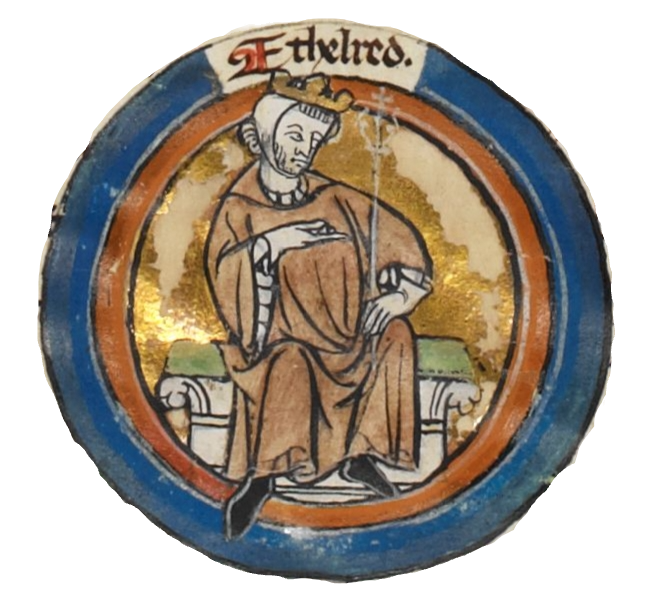
It started in Britain when King Æthelred the Unready^ paid a massive 10 thousand lbs of silver to the Danes in 991 AD; the Danegeld soon became a common, though controversial, strategy for dealing with the Vikings.
Some refused to pay, continuing to fight, others like Æthelred, chose, every few years, to surrender larger and larger gelds. Over his life King Æthelred shelled out ~140 thousand lbs of silver to various Vikings including Olaf Tryggvason, Thorkell the Tall & Sweyn Forkbeard (first Viking to claim the English throne c.1013.)
The result, naturally, was Viking raiding season became "collection" season with longships sailing town to town demanding silver & food. (Needless to say many Danes found this tribute system, without having to fight, far preferable to actual dangerous raiding!)
Though the geld theoretically spared lives that would have been lost in battle, in practice it was not a marked improvement, but a crippling financial burden. Essentially towns had to choose between war or forced starvation, (knowing payment only bought time until the next demand.)
"... if once you pay the Danegeld, you never get rid of the Dane."
- Rudyard Kipling poem: Dane-geld, c. 1911
Even in lands fully under Scandinavian rule, like the Danelaw,† protection payments continued as a 'tax' (gafol.) Viking King Cnut, (son of Sweyn Forkbeard and ruler of all Denmark, Norway & England) continued collecting the Danegeld as a regular land tax to pay for his standing army and huskarls /hirð.
As Viking Kings conquered foreign kingdoms through battles & bribes, they used their wealth to also centralize power back home for the first time with (semi stable) organized courts, minting their own coinage and building a vast Nordic Empire that reached into western Europe and across the British Isles.
As Viking settlements grew in size & wealth, some built defensive Trelleborg fortresses;
Trelleborg - likely = fortress built by slaves [Danish træl = slave (träl in Swedish) from ON thrall + borg = fortress or city.] A circular ring- fort spilt into quadrants c.~ late 10th century. [Alternatively from trel (pl. trelle) = related to wooden staves (poles; which covered the walls.) The first was discovered in the 1930's, in Denmark, (a few hours from Copenhagen) and it gave it's name to the area where it was found as well the style of fort.
With ever more frequent campaigns, some Vikings also began to winter on islands nearer to their targets, rather than returning to the Scandinavian mainland. They made camp in places like Shetland & Orkney off the north coast of Scotland, the Isle of Man between England & Ireland and the Faroe Islands between Norway and Iceland.
Theses new settlements served as home-bases between sailing seasons and grew into substantial trading centers for slaves and plundered goods won on raids.
Visit Viking Forts, Posts & Founded Cities...
Trelleborg in Denmark - best-preserved Viking ring-fortress, with longhouse foundations & reconstructed house. Foundations of Danish forts are also @ Aggersborg (the largest), Borgring, & Sagnlandet with Lejre Land of Legends archaeology center as well as in Sweden on Bornholm Island
Aarhus (Aros) | DE - Viking trading post with underground Vikingemuseet; preserved wooden streets, house foundations & reconstructed Viking-Age rampart. They also host Denmark’s biggest Viking event; the Annual Viking Moot
York (Jorvik), Viking capital of England, has a Viking Centre with reconstructed Viking streets, and hosts the biggest Viking festival in the UK
Additional Viking founded cities include: Nottingham (founded as Snottingham: homestead of Snot’s people), Derby / Djúraby (farmstead with deer / animal farm), Leicester / Ligera ceaster, Stamford, Northampton & Norfolk / Thetford. Lincoln, a Roman city, was re-founded by Vikings and Norwich, the largest city in East Anglia was heavily influenced by the Vikings.
Dublin [Dubh Linn = Black Pool] - a longphort (ship fortress) & Viking capitol of Ireland has Dublinia, Wood Quay archaeological site & Kilmainham–Island bridge warrior cemetery; largest Viking cemetery outside Scandinavia (No graves visible today.)
Ireland's also has Reginald’s Tower (part of Waterford's city walls – Ireland’s oldest city c. 914 AD) only surviving building named for a Viking (Ragnall).
Garðar & Hvalsey Church | Greenland: best-preserved Norse ruin in Greenland. Bone tools & ruins have also been found @ sites like Tasiilaq’s on the east coast.
* Naddodd, a Viking from the Faroe Islands, is given credit for this discovery after he was blown off course by storms, but recent archaeological excavations at sites such as Stöð reveal Norse longhouses c. ~800 AD, pre-dating his landing, indicating earlier sporadic occupation.
** Dendrochronological precision, using a solar storm's cosmic ray signature in tree rings, dates Newfoundland's wood-cutting to exactly AD 1021! (The sole verified European foothold in the Americas prior to 1492.) The settlement was soon abandoned, however, due to clashes with indigenous tribes ( that Vikings called Skrælings) and the difficulty of resupplying across the Atlantic.
^ Originally called the 'Un-ræd' meaning the 'un-counseled;' a derogatory play on his name; 'noble-counseled' [Æthel (noble) + ræd (counsel)] - earned in part because of his failures with the Danes; after generations of peace before him, his reign was immediately plagued by Viking invasions and the 'foolish' policy of the the Danegeld ensured the raids continued until his death.
'Un-ræd' morphed to 'Unready' as 'ræd' fell out of use & memory and the similar sounding 'unready' conveyed a similar meaning. (Æthelred was thrust into kingship by the assassination of his brother and had not been groomed for the role so was also literally unready.)
† The Danelaw encompassed the kingdom of Northumbria plus parts of Mercia, and East Anglia
⫘⫘ ᚢíᚴᛁᚾᚴᚱ ⫘⫘
A Viking by any other name...
Central European Germans called the sea raiders Ascomanni, meaning ashmen; for the Ash wood used to build their boats. Anglo-Saxon called them simply Dene, i.e. Danes, (and eventually the lands settled by these Vikings in Britain was called the Danelaw.)
In Ireland & Scotland they were called Lochlanach, cognate with the Welsh name for Scandinavia, Llychlyn; both literally meaning 'land of lakes' or 'swamps.'* And Dubliners called them Ostmen, or east-people, as they originated east of the British Isles (Today's Oxmanstown in central Dublin was one of the Ostmen Viking settlements.)

The Vikings had several endonyms for clans, one of which was also east-men; Austmenn, but it was in reference to the east of Scandinavia as opposed to the Norwegian Norðmanna (north-men; north of Denmark) and Vestmenn (west-men) of the region. They also used the term Áttmenn meaning oarsmen, or referred to themselves by tribal affiliations, such as the Dani (Danes) or Sviar (Swedes.)
Slavs, Arabs and Byzantines called Swedish Vikings, (common in the east) Rus' or Rhōs (Ῥῶς), likely derived from rōþs = related to rowing, [and/or a borrowing of the Finnic name for Sweden, the cognate Ruotsi.]
These Rus who raided and then settled Eastern Europe eventually gave their name to modern Russia and Belarus.
The Slavs and Byzantines also knew some as Varangians, [ON: Væringjar,] meaning sworn men. These vikings were so renowned for their fighting skill and bravery they were hired to be bodyguards, sworn to protect the Emperor of Byzantine (i.e. the later Roman Empire) and were known as the Varangian Guard.
It wasn't until the 19th century and Erik Gustaf Geijer's idealized nationalistic poem "The Viking," that Viking as a proper noun for specifically Scandinavian raiders became common, and anachronistically expanded into the catch-all name for the entirety of the medieval Norsemen.
From ~793 to 1066 AD, the Age of the Viking, the Norse developed a reputation of excessive violence; mass killings and widespread enslavement of captives. Needless to say, the fact that their targets for sacking were frequently innocent men of the cloth at undefended monasteries didn't help their PR, nor did the fact that these men were the scribes of their day;
In a rare turn of fate, the victims were the ones to write the history books, and their depictions of these merciless Norsemen painted an ugly picture indeed.
The Anglo-Saxon Chronicle describes in shocking detail the first of these attacks on Britain by these "heathen men" - which devastated St. Cuthbert's Priory at Lindisfarne.**

In hindsight the chroniclers interpreted preceding whirlwinds, lightning and "fiery dragons" in the sky, as divine omens of the coming of the hirð. They believed the destruction of this and future abbeys & altars, the theft of God's treasures and the raping & slaughtering of His faithful servants were evidence of a specifically anti-Christian animus, and the heathens every disgusting act against the church was recorded in detail for all posterity to condemn.
While the pagan Norse were certainly not pro-Christian, it's more likely they targeted monasteries due to the accumulated ecclesiastical wealth and easily exploited isolation rather than as an intentional attack on Christianity itself.
Modern historians and a renewed romanticized mythos of the 'noble' viking has pushed back a bit against the more brutal portraits painted by the monk scribes. Viking 'defenders' like to emphasize egalitarian aspects of Scandinavian society, like the T Things, to argue that any violence on raids was the exception (and not as bad as the monks claim anyway) rather than an inherit feature of their culture.
No evidence has been found, for example, that Vikings drank from of the skulls of vanquished enemies; a misconception based on a passage in the poem "Krákumál" speaking of heroes drinking from ór bjúgviðum hausa = branches of skulls - a reference to drinking horns mistranslated in the 17th century as referring to the skulls of the slain.
But their is no denying the fact that Vikings, particularly those from Norway, were an extremely violence based society, even outside of raiding. It was a more violent time in general, but even compared to contemporary raiders (like the Danes) the Norwegians proved to be an excessively aggressive bunch.
Viking-era skeletal remains in Norway show frequent weapons trauma suggestive of execution or ritual killings, not mere warfare casualties; one examination found 72%! of males and 42% of females suffered weapon-related injuries. And mass grave evidence in Dorset revealed decapitation executions of over 50 individuals in just one Viking ravaged village.
Historically Signifigant Sites...
Saint Cuthbert's Priory Ruins @ Lindisfarne (Holy Island) | England - site of the first Viking attack on Great Britain
Sverd i Fjell (Swords in Rock) bronze monument @ Hafrsfjord site of the 872 AD battle where Harald Hårfagre (Harold Fairhair) defeated rival kings, unifying Norway. There's also Harald's royal farm, Avaldsnes Viking Village with reconstructed longhouse & smaller turf roof buildings next to a medieval church.
Pîtres fortified bridge where Charles the Bald failed to stop Viking fleets in the 9th century resulting in Rollo’ making Normandy the Viking capital in France. (The Bayeux museum has military artifacts from the Norman conquest of England & a tapestry featuring Viking-style longships.)
* Lochlanch may originally have referred to a mythical Irish undersea world of monstrous sea raiders & giants called Fomorians, and it is not a stretch to see how the it became associated with 'monstrous' Scandinavian raiders.
Celtic Irish + Scottish called themselves Gaels or Gall, = those who speak Gaelic, and as Vikings mingled with Celts terms Finn-Gall (Norwegian Viking), Dubh-Gall (Danish Viking) and Gall Goidel (foreign Gaelic) were adopted to distinguish peoples descended from vikings of different origins.
** The assault on Lindisfarne Priory, an island monastery off the NE coast of Britain, is generally considered to be the onset of the Viking Age & widespread Scandinavian expansion, but the Norse were, no doubt, engaging in smaller coastal raids closer to home for some time that simply weren't documented.
⫘⫘ ⚔︎ ⫘⫘
The Warrior & his Women
Fascination with Norsemen reached a peak during a so-called Viking revival of the 18th + 19th centuries as Europe experienced waves of Romantic nationalism. Much of what lingers in the in public imagination can be traced to this era. This modern "Viking Hero" in pop culture, from comics to the History Channel; the tall, blonde and braided warrior with his obligatory ram's horned helmet, however, is only semi- accurate.
For one thing, Norse helmets (worn by less then 10% of professional warriors, to begin with) were merely the conical, simple nasal type, with absolutely NO HORNS. The fur trimmed horned helm became ubiquitous only because it was used in Wagnerian opera productions , (and Bugs Bunny cartoon parodies of the same.)*
Shockingly, Old Norse had no word that directly translates to warrior; fighting men were referred to alternatively as drengr, (a gallant / chivalrous man), rekkr (an upright, courageous, bold man), and bragnar (heroic men) interchangeably.

Bragnar that could afford it wore only light armor, to allow for maximum mobility, (usually leather, including the helmet; iron and chainmail, being labor-intensive, were worn only by very wealthy nobles.)
And despite associations with double-headed bearded axes,** versatile and inexpensive spears were the most common weapons; either krókspjót (hooked spears) or the larger-headed chopping spears, höggspjót.
When axes were used, in ship building or battle, they would have been the throwing style Mammen Axes, the extra long Dane Axes, or simple breiðöx (broadaxes.)
Bows and Arrows were also used and bóndi may have carried a seax (knife) as a side-arm, but full length, costly swords were rarer and highly prized, often featuring elaborate decretive forging patterns. These important weapons (swords & axes, e.g) would have been named, frequently after she- trolls.
(Far left: the Gjermundbu helmet, only original Viking helmet; made of iron, found in Norway c. 10th century)
Norsemen did, however, use the round wooden skjald (shields) reinforced by leather & iron, just like those carried by Hägar the Horrible and many a sports mascot. They might be decorated, painted with mythical scenes, and were the subject of odes with a whole sub-genre of "shield poems" dedicated to them; like the 9th century Ragnarsdrápa.
Despite the old stereotype of towering Scandinavian warriors, and the newer claims of multi-racial origins, (at least according to Netlix,) genetic studies reveal the average Norsemen was only 5' 7" (5' 1" for women), with fair skin and varied hair colors (mostly blond in what is now eastern Sweden, with red hair more common in western Scandinavia.)
In some regions men bleached their hair, which most wore shoulder-length with equally long beards, (thralls were usually the only men with short hair, though those involved in warfare, like Vikings, may have had slightly shorter hair / beards for practicality sake.)
Females had long hair with girls usually wearing it loose or braided, but married women often wearing it in a bun. Essentially Vikings looked exactly like what you would expect the ancestors of modern Scandinavians to look like, only shorter.^
The most infamous of Viking warriors were the Berserkers, elite fighters in a trance-like fury of uncontrollable rage (berserkergang.)
Berserkr - (plural berserkir); O.N compound, most likely literally meaning: bear-shirt, as in 'someone who wears a coat made out of a bear's skin' [ber - assumed to mean bear + serkr = shirt.] Alternately, but less likely, interpreted as bare-shirt, as in 'warriors that went into battle without armor.'
The modern term to "go berserk" meaning "to go crazy," is, of course, named for these men. The Old Norse term was hamask = to change form, which some interpret to mean berserkers where considered shapeshifters who took on a bears form in addition to it's strength.
The term also covered warriors associated with wolves; Ulfheðnar of Norse mythology, e.g., were described as "mad as hounds or wolves, bit[ing] their shields... neither fire nor iron had effect upon them... [and] 'going berserk'." The sagas even tell of literal transformation of men into wolfs, (clearly related to later werewolf tales.)
These wild battle traditions may have evolved from hunting magic rituals of Germanic animal cults (bear, wolf or boar), and could be related to images found of warriors wearing bear or wolf heads/ skins on various columns and horns.
In the tales, bodies of dead berserkers are laid out in bearskins for their funerals and this bear-warrior symbolism survives to this day in the bearskin caps worn by Danish royal guards.
The practice was outlawed, however, in Iceland in 1015 AD. It's been proposed that berserkers' heightened battle state was induced by drugs, like henbane or fly agaric mushrooms, however skeletal analyses has shown no chemical residue, so psychological or ritual induction is usually believed to be more likely, if these elite warriors existed.
[With no archaeological evidence, some theorize berserkers are an exaggeration of literature, but as their main distinction was wild behavior in battle, there might not be physical evidence to find... and it would hardly be necessary to outlaw a nonexistent practice.]
The sagas also speak of skjaldmær, or shield-maidens, which some interpret as women warriors. These claims are also controversial but there is some archeology evidence in support of female vikings.†
(Center: the Birka grave site (Bj 581) containing a female with weapons & equestrian gear)
Fundamentally Vikings were a patriarchal society; marriages were arranged and wives were subordinate to their husbands. Women were barred from speaking at Things and testifying, property & status passed primarily father to son, and selective infanticide, by exposure, of female newborns is well documented to prioritize male heirs.
Men also openly practiced polygyny & concubinage, (mistress' called frilla might live in the home with a man & wife, and offspring from both could inherit.) But Norse women did enjoy a slightly higher degree of independence compared to their contemporaries.
Women were active as priestesses (gydja) & oracles (sejdkvinna) as well as poets, rune masters and medicine women. They had the right to own / manage property when widowed, wives could initiate divorce and remarry, and unmarried woman, (mær or mey,) could choose where to live once they turned 20; rare rights in middle ages.
All of this marked Vikings as somewhat unusual, so it isn't totally inconceivable that some woman fought. But the physicality and extreme nature of the violence of raiding makes it unlikely that a woman would last long as 'just one of the hirð' - if anything, a rare women of status might have participated symbolically in a chief-like role, but it seems improbable that a female would have actually fought along side and against men.
Notable Norse Warrior Sightseeing ...
8th century Repton Crypt & St. Wystan’s Church | England were Great Heathen Army's Cnut the Great & Ivar the Boneless lay, plus a nearby mass grave of 300 Vikings
(DNA supports Ivar, but Cnuts alleged bones were mixed in with others so not confirmed)
In Denmark King Cnut IV (Last Viking King) is buried @ St Canute’s Cathedral (Sankt Knuds Kirke) | Odense. (Foundations of Nonnebakken – one of Harald Bluetooth’s huge Trelleborg-style ring fortresses is also near by)
Buried in Norway's Nidaros Cathedral | Trondheim, are Olaf Haraldsson (St Olaf) King & patron saint of Norway, and probably King Harald Hardrada.
Eric the Red sites abounds. There's Eiríksstaðir in Iceland with a reconstruction of the turf longhouse where he grew up / lived before he was banished for murder.
And in Greenland there's Eiríksfjord, a fjord he named for himself when he first landed, plus Brattahlíð (the steep slope) his farmstead (likely birth place of his son, Leif Erikson,) with reconstructed longhouse, ruins of the original farm, Thing meeting circle & banquet hall.
* The costume designer drew on the popular Victorian romanticized ideas which blended the Viking Age with earlier finds. Horned helmets appear in petroglyphs and Bronze Age archaeological finds, (some 2,000 years earlier) probably used for ceremonial purposes, but no horned helmets have ever been found that date to Viking Age, nor would they have been very practical for raiding
** Like horned helmets, no surviving examples, artwork or descriptions from records support the existence of double-bitted (headed) axes being made or used by Vikings. The Norse considered them impractical; overly heavy & cumbersome, and wasteful (requiring twice the precious metal to make for no gain in function.)
^ Non-Scandinavians in Viking raids, of course, would have varied, but none of those Germanic, Celtic and Slavic people groups would be any where near as ethnically diverse as TV shows like to imagine, with Asian and Black Africans portrayed as as early Nordic peoples. It is certainly possible that a small percentage of slaves were of eastern or sub-Saharan descent, as Viking certainly got around to the southern trading routes, but the Norse where primarily exporters of slaves (from European raids,) sold to the Arabs, rather than the other way around, - they caught their own slaves daily, they would have been no need to import additional foreign slaves into the their system.
﹏ 𓊝 ﹏
The Galleys

Vikings are nearly synonymous with Longships, or Dreki / Drekaskip meaning dragonships, (with bows carved as dragonheads, aft as a tails & the sail(s) = wings.)
These masterful galleys are what that made Viking possible.
A Viking dragon sighting on the horizon, must have been a terrifying thing to behold!
Viking settlements sprouted and flourished among the already seafaring / trading communities where Scandinavian sailors had invented and perfected advanced nautical technology for their day; regions like Scania on the Swedish coast, and the islands like Danish Zealand, the Germanic indigenous population of Bornholm and the Baltic/Fennoscandians of Gotland.
Like all contemporary sea navigation, they relied on 'reading' celestial bodies, and indicators such as bird flights or wave patterns (both denoting nearby shores.) There are also references in the sagas to sunstones, like calcite crystals, to detect the sun's location when skies were overcast , but no confirming physical evidence has been found.**
One advanced technology that's not disputed, however, is the use of clinker-built (lapstrake) construction for their ships, with overlapping oak or ash planks riveted together creating lightweight, flexible hulls.

Built for speed, powered by oars & sails, these versatile vessels enabled both shallow-water navigation (in waters as low as one meter) and had blue (deep) water capabilities, making both hit-and-run tactics in coastal waters & rivers, and sustained open ocean voyages possible, (even transatlantic crossings.)
Longships measured 17 - 35 meters in length with 20 - 30 rowing benches for pairs of oarsmen and a central, square (removable) mast rig. They had special attachments on the hull for the warrior's shields to be stored, called shield lists, which protected the rowers from the waves and strong wind produced as the galley achieved speeds up to of 5 - 10 knots.
The longships were so important to Viking status & culture that they were the center piece of ceremonial burials.
Most are familiar with the cinematic version; a warrior set out to sea, ship turned, via flaming arrow, into an impressive funeral pyre. Its a dramatic image popularized by Hollywood, but like the horned helmet, it may not be accurate.
Way back in the Iron Age, pyre cremation, (with ashes later buried in an urn,) seems to have been the most common funeral tradition around the Baltics 🔍. And there is evidence that pyres sometimes include boats burned along with a body, but the bonfires were on land.
It's hard to say with certainty if a similar, later Viking Age tradition of floating pyres was ever practiced because, by definition, the evidence would be lost to sea, but there are allusions to the practice in literature.

In Norse mythology when the murdered god Baldr was to be laid to rest on his ship, Hringhorni,^ known as the "greatest of all ships," it was so big and heavy that even on rollers Thor couldn't push it into the ocean, and the giantess, Hyrrokin, had to be asked for help.
She came riding in on a wolf and flung the ship down the rollers with such force that the friction created sparks which caught the ship on fire.
(In the story Baldr's wife died of grief at his loss and was also laid on the ship pyre, as was an unfortunate dwarf, in the wrong place at the wrong time, that Thor kicked onto the fire and who was burned alive.)
Whether or not pyres floating out to sea were real, we do know that Vikings continued to practice land cremation (mostly in Sweden & Norway) as well as inhumation, (more frequent in Denmark.)
Just like the pyres, rich Vikings were buried with grave goods including weapons and jewelry etc. believed to accompany the dead into the afterlife, and the burial mounds of the most important Vikings also included their ship.
Longships & Burial Mounds...
Burial mounds for King Gorm the Old (First historically certain king of Denmark) & his son Harald Bluetooth @ Jelling | Denmark contain a prehistoric stone ship enclosure over 350 meters long. (Royal burial mounds can also be found in Uppsala)
(Harold's bones have been confirmed and moved to the Cathedral, Gorm's were stollen in antiquity, but his empty coffin was found in the 19th century)
The Gokstad ship, largest preserved longship in Norway; 23m long with 32 oars, is at the Viking Ship Museum | Oslo along with the elaborately carved Oseberg ship.
Also in Norway are the Borre Mounds: massive mounds with elite graves, ships, weapons & sleighs. At the Lofotr Viking Museum there is a reconstructed Viking ship that you ride.
Lerwick | Shetland has two complete Viking boat burials from Unst on display @ their Museum & Archives. In Norwick you can visit the Viking boat burial beach, where a skeleton with sword, shield, & whalebone plaque reading “Unst Viking” was found (though it's now reburied.)
(They also host Up Helly Aa: Europe’s biggest Viking fire festival. )
Björnshögen, Munsö Island | Sweden has the burial mound of Bjorn Ironside
* In addition to longships Norse also employed broad-beamed knarrs that could carry up to 24 tons, for cargo transport, with broader hulls and deeper drafts for stability.
** Modern experiments have achieved up to 100% accuracy in position checks using sunstones, but their is no direct archaeological evidence of their use by Vikings, just literary allusions.
^ Meaning "ship with a circle on the stem" (ON)
⫘⫘ 𖣂 ⫘⫘
Viking Vallor Verse &
Much of what we know about Viking culture & religion comes from their Skaldic Poetry; Oral Sagas & Fornaldarsagas (literally; story/history of the ancient era) tracing at least as far back as the 9th century.
Skáld - ON: skɔːld, Icelandic: skault, meaning poet. Professional Scandinavian poets that served as court entertainers, telling tales in verse of battles, voyages & myths, often in honor of a kings exploits. Old High German variant stem skeltan, [Proto-Germanic: skeldan] = to scold, blame, accuse, insult (in the same sense that a jester/ fool could scold a king) - The person doing the insulting was a skelto or skeltāri, West Germanic scop, likely cognate to English scoff & scold, related Proto-Germanic: skalliz = sound, voice, shout and Old High German skalsang = song of praise, psalm.
Some of the poems were plain speech and some in song form and, like Shakespeare a few centuries later, Skálds created many a new descriptive turn of phrase; inventive, metaphorical compound words like "whale-road" for the sea.
Works based on this oral poetry continue to inspire, like the 13th century Völsunga Saga which contains the sagas of Sigurd & Brunhild ( Scandinavian cousin of the Nibelungenlied that Wagner's Ring Cycle was based on ) and the fornaldarsaga of Ragnars Saga Loðbrókar, the basis of the modern History Channels series "Vikings."
The original skálds often (claimed) to be eye witnesses of the events in the poems, theoretically, making the sagas excellent sources for the early Viking Age, but they frequently mix mythological elements into the narratives, not to mention the transition from the oral compositions to written forms didn't even begin until ~1000 AD, as much as 200 years later, right around the time of Scandinavia's Christianization** which somewhat colored the content of the poems.
Norse paganism in the early Viking Age was a complex polytheistic system, but the popularity of Wagner in the 19th century, and now Marvel comics, has ensured that many of it's gods are remembered (at least by name) even today;
Odin, the Allfather, the Valkyrie escorting warriors to Odin's hall in Valhalla as their reward for a heroic death in combat, Loki the trickster and of course the quintessential Viking god, Thor, patron of thunder, with his hammer Mjölnir, among others, all waiting for the final end- days battle, Ragnarök, where the gods fall to giants and monsters, the world floods then regenerates greener, starting the cycle over again.
This sweeping worldview of warring gods, that elevated heroic death in combat, both reflected and incentivized Viking aggression as a path to eternal feasting and glory.
The Norse cosmos centered on Yggdrasil, (the World Tree) an immense ash tree linking nine worlds, including Asgard (gods' realm), Midgard (humanity's, i.e. earth), Hel's shadowy realm and Niflheim (the icy depths.)
Norse rituals included trance-induced divination, shape-shifting völvas (see-ers) using special staffs & chants plus an emphasis on blóts; seasonal festivals with communal sacrifices of livestock, (and sometimes humans,) where blood was sprinkled on altars or idols to grant fertility, victory, or calm the seas.
Archaeological finds, like cult figurines and weapon offerings in bogs at sites like Uppåkra and Uppsala, plus strangled skeletal remains at temple sites, all support the picture painted by the sagas of ritual practices and divine veneration.
Norse mythology has deep roots, likely tracing much of it's core back to a pre-Grecian, proto-European paganism (as it share many elements with other European pagan traditions.) And much of it's iconography & value system survived the Christianization of the region. Thor's hammer pendants, for example, coexisted alongside crosses well into the 11th century.
Many different collections of these mostly anonymous pre-Christian oral traditions had been compiled by the 12th century.** The sheer number of sagas combined with contradictions in mythology between various versions was confusing, so ~1220 AD an Icelandic poet & scholar, Snorri Sturluson, decided to create a sort of encyclopedic systematization of the historical & mythological content contained in the poetic traditions.
He called his collection the Prose Edda, & retroactively, the various untitled collections of poems came to be referred to collectively as the Poetic Edda;
(or Elder Edda, with the Prose thus becoming the Younger Edda.)
Edda - [etymology unknown], likely a word for great-grandmother, or ancestor, it's used in the Eddic poem Rígsþula as the name given to a great-grandmother (represented as the mother of the thralls) - [Possibly derived derived from a root for an older female relative or foremother]. As a title for the prose, Snorri may have been saying the tales were "from our ancestors," or associating them with ancient wisdom. Alternatively in may be linked to Oddi, the place in Iceland were the author Snorri was educated, or derived from the ON óðr = poetry

In the time between the Poetic Edda transcription and the Prose Edda's compilation of the tales, the Christianization of the region had greatly accelerated.
Snorri didn't alter the original pagan poems but he did interpreted them through a fully post-pagan lens, and adopted the scholarly theory /presumption that the mythological stories originated from real historical events in an attempt to align them with Christian realism sensibilities.
With the conversion of the Norse to Christianity their shipbuilders put their superb woodworking skills towards building some of the most unique & impressive wooden church structures ever constructed. Called Stave Churches (stavkirker) they were constructed in Norway (where stone was scarce,) from the 11th - 13th century, entirely with axes rather than saws. (The earliest even used wooden nails rather than iron!)

Distinguished by their posts (or poles / staves) -and-lintel timber framing and tiered roofs covered in shingles carvings they blended Christian iconography with lingering Norse motifs such as serpents and mythical beasts.
Norse Mythos & Stave Tourism...
The Sigurd Carving | Sweden is a dramatic rock carving of dragon-slaying hero Sigurd, Earl of Orkney (carrier of the raven banner) from Norse legend.
Only 28 complete Stave churches survive today including Borgund Stave with its elaborate exterior decorations & internal colonnades, and Urnes Stave - a UNESCO site, and Gol (relocated to Oslo Folk Museum)
In Orkney you can walk the halls described in the Orkneyinga Saga like St Magnus Cathedral & [foundations of ] Earl’s Bu, drinking hall where Sigurd was murdered .
Vikings also broke into Maeshowe chambered cairn, (built ~2800 BC) and left the world’s largest collection of runic graffiti: 30+ inscriptions & dragon carvings including praise for the "[Ragnar] Lodbrok's bold sons" of the sagas (Halfdan, Ivar the Boneless, Björn Ironside, Ubba, Sigurd Snake-in-the-Eye, & Hvitserk.)
Norway's national monument, a 17m granite obelisk, Haraldshaugen is built on a mound that the sagas claim as Harald Hårfagre's burial site.
Stavgard Vikingagård | Gotland is reconstructed Viking village built on ruins of a chieftain's great hall, possibly linked to the Beowulf legend. The island also has unique Picture Stones with carvings of ships, warriors & myths plus a Viking museum in Visby
* This timing is not coincidental, Scandinavian rulers converted en masse between 960 and 1020 AD it was this Christianization that also spread literacy and scholarly an emphasis on recording both history and current events.
** There is much debate about were and when these poems where composed, and when they were first collected and transcribed, (the earliest known skald from whom we have verses is Bragi Boddason, known as Bragi the Old, a Norwegian skald of the first half of the 9th century,) but the most complete version of the transcribed Poetic Edda that has survived, the Codex Regius, with 31 poems, was not likely compiled until ~13th century.
⫘⫘ 𓄿 ⫘⫘
Lasting Legal, Leisure & Language Legacies
The Viking Age officially ended in 1066 AD with the defeat of Viking King Harald Hardrada (+ his 300 ships,) the successful invasion of William, Duke of Normandy and the cessation of further major Scandinavian invasions.
Ironically, however, Britain hadn't actually escaped Viking rule. William the Conqueror was himself a descendent of the infamous Rollo the Walker, Viking besieger of Paris & founder/ first ruler of Normandy (c. 911 AD) a Viking stronghold in France.
The Norman conquest was only 150 years, a few generations, removed from being a direct Viking conquest of all of Britain!
Regardless, a unification of Britain began with William and the Viking raids came to an end. It was a turning point for the Norse and their nautical based power; Viking kings shifted focus to internal consolidations of clans within the Nordic realms, building up what would become the nation states of modern Scandinavia.
Gone... but not forgotten, the Viking presence can still be felt on every shore a Longship landed. Norse rulers in the Danelaw introduced Scandinavian legal practices to the Isles, with their emphasis on communal assemblies and compensation over stricter Anglo-Saxon penalties, greatly contributing to the evolution of English Common Law.
In Iceland, the Norse had established the Althing [Alþingi, Icelandic: ˈAlˌθiɲcɪ = general meeting] in 930 AD, a legislative & judicial assembly of chieftains still l running today, making it the oldest continuously documented parliamentary institution in the world.
Today Vikings are associated with Minnesota football* but historically they're more closely linked to Ice Hockey, with a sport called knattleik played with a bat and small hard ball on a smooth surface of ice.** Games might last all day, and body contact & intimidation were vital strategy; (knattleik trash talk is recored sagas, 😂) It even included a penalty box. The Norse didn't have skates though, instead they may have used tar and sand on the soles of their boots for traction.
Linguistically, the Vikings contributed over 100 words to English, including sky (ský = cloud,) and window (vindauga= wind-eye,) with Norse roots in husband and law. Not to mention the toponyms: place names ending in ster, wick, ness, voe, or ay are likely Old Norse, like Lerwick^ and roads with the suffix gate, from gata = street, like Coppergate or Micklegate; and of course Thursday is from Thor's day.

Even modern technology pays homage to Vikings, Bluetooth is named for Harald Bluetooth, (Viking King of Denmark & Norway) & it's logo based on the Nordic runes for his initials.
Their largest, lasting contribution, however, was likely Old Norse's influence on the evolution of Old English into the Modern English that ~1.5 billion people speak today. As Vikings infiltrated into British society, their less complicated speech patterns were adopted by the natives and led to the grammatical simplification of English. Nouns lost their gender, conjugations were reduced to bare -s suffixes and dangling preposition were added, (to the chagrin of many a future English Prof.) all features of Old Norse.
More Things Viking...
Thingvellir (Þingvellir) National Park | Iceland - UNESCO site of the Alþingi (All-Thing) world's oldest continuous parliament; with it's Law Rock (Lögberg), where laws were recited & drowning pool used to execute women convicted of crimes.
Gulatinget (Gulaþing) one of four great regional assemblies of Norway, marked by a modern monument & stone circle. Additional Norwegian Thing sites can be found @ Frostatinget & Njardarheimr (with living Viking village) both by beautiful fjords.
Anundshög Tingstad - Sweden's best-preserved large Thing plain. Swedish Things can also be found @ Aspa Löt , Judgement Hill & Liongaþing
Isle of Man has one the world’s oldest continuous parliaments @ Bierg Gemot (Court Hill); with four stepped grassy tiers where laws are still proclaimed every July 5th in Manx & English.
Faroe Islands also has one of the world’s oldest parliaments still in use; Tinganes, Tórshavn with red wooden, turf roof government buildings on the ancient site.
* Named for the regions high Scandinavian population
** There was also a land‐based ice version called, svell.
^ 95 % of local names on Shetland are Scandinavian!
I've been lucky enough to visited lots of historic Viking sites on my travels, but there are so many I'm sure I've missed a few!
What are your favorite Viking haunts? Are there any I haven't mentioned that are worth a trip? Let us all know about your experience in the comments!


Comments